
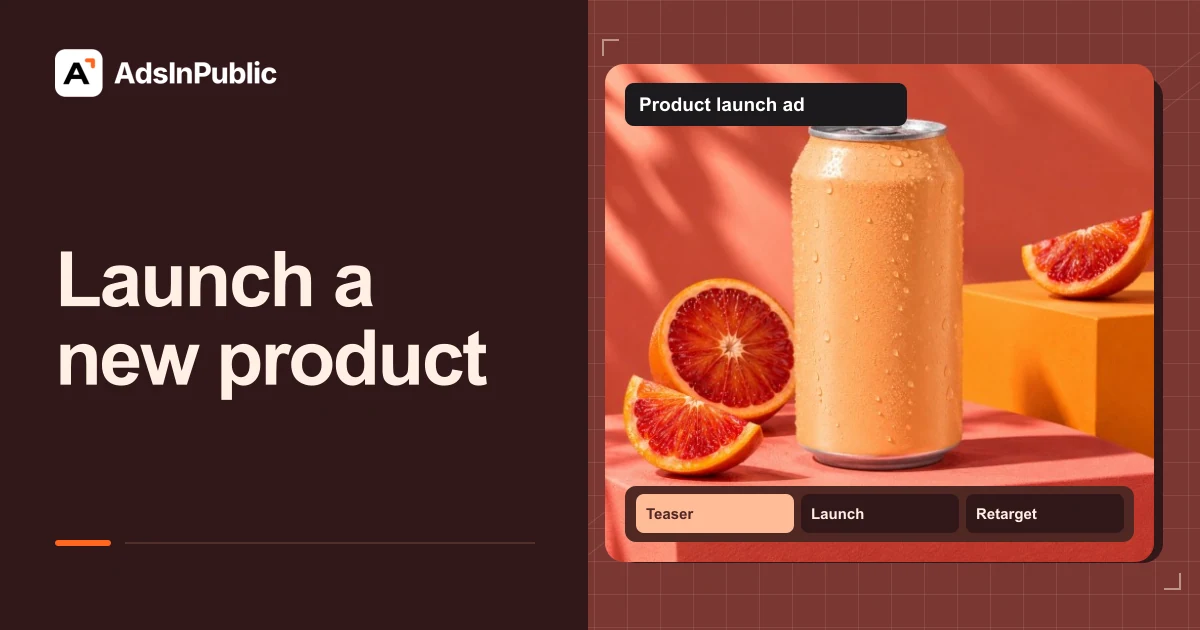
Before launch, build an audience and collect social proof. At launch, put your budget behind one or two channels and track conversions from day one. A new product has no conversion history for ad platforms to learn from, so start with controlled spend and watch which offers and audiences drive sales before you scale.
Before you spend a dollar: three things that decide everything
One sentence of positioning. “A [category] for [audience] that [specific outcome].” If the sentence takes two commas to survive, the ads will be mush. Every creative hook you write later is a variation of this sentence, so sharpen it now: the audience you can name, the outcome you can prove, and the difference you can defend.
Tracking before traffic. Install the Meta Pixel and pair it with the Conversions API so purchases still register when browsers block cookies, with event deduplication so the two sources don’t double-count the same order. Pair the TikTok Pixel with Events API for TikTok campaigns. The reason this matters more for a launch than any other campaign: your first weeks of data are unrecoverable, and conversion-based optimization (the thing that makes ads efficient) literally cannot run without events to optimize toward. An account that fires its first pixel event on launch day always underperforms one with weeks of warm signal.
A social-proof plan that survives the FTC. New products have no reviews, and the fastest way to fill that gap is also the one the FTC explicitly prohibits. The fake-review rule (16 CFR Part 465, finalized in August 2024) bans testimonials that misrepresent they’re from someone who exists or actually used the product, including “AI-generated fake reviews” (FTC’s announcement). What you can do: give the product to real people, collect honest opinions, get written permission to quote them, and disclose it when reviewers received the product free (FTC’s Endorsement Guides FAQ). Real quotes from real users, clearly sourced, are also simply better advertising. A synthetic testimonial reads as synthetic, which is the opposite of the trust a launch needs.
Phase 1: the warm-up (two to four weeks before launch)
The warm-up exists to solve the cold-start problem. Three moves:
Fire the pixel early with cheap traffic. A small Traffic or Engagement campaign can give the pixel visitor data before you launch. Meta’s Advantage+ audience guidance identifies these as objectives where automation can lower cost per result. Meta’s minimum varies by country, objective and bid strategy, so check the budget alert in Ads Manager (Meta’s minimum-budget guidance). Reddit’s floor is $5 per day, enough to verify delivery (Reddit’s Get Started guide). Allow more time and spend before drawing conclusions.
Build niche audience the direct way. If your product serves an identifiable community, Reddit’s community targeting is the sharpest cheap tool available: it reaches users who subscribed to or recently viewed specific subreddits, and Reddit advises including at least 15 communities per ad group for best results (Reddit’s audience guide). One nuance the same page makes explicit: those ads can appear anywhere the user browses Reddit, not only inside the subreddits you picked, so judge it as interest-based reach with community precision, not as a placement guarantee.
Start content before you start ads. Organic posts on TikTok and Instagram, a few honest unboxings from people you actually know, a waitlist page that collects emails. Every view and follower is audience your launch ads can retarget. Meta’s product-media ads specifically retarget “people who’ve shown interest in products on your website or app” (Meta’s product-media guidance), and that feature needs a history to retarget. The waitlist deserves more respect than it usually gets: it’s the cheapest qualified audience a launch can own, because everyone on it raised their hand before a single ad dollar was spent. A simple “first 100 orders get founder pricing” mechanic turns the waitlist into launch-day revenue and gives your first ads immediate social proof to work with.
Phase 2: the launch burst (weeks zero to four)
This is where most of the budget goes, and the discipline matters more than the spend.
Pick one primary channel and fund it properly. For a visual consumer product, Meta or TikTok; for something with existing search demand, Google Search; for a niche hobby product, Reddit community targeting deserves a real test. Splitting a launch budget across five platforms guarantees none of them collects enough data to optimize, the same concentration logic that governs small accounts generally. Meta’s own learning guidance is explicit that an ad set usually exits learning only after “about 50 results in the week after the ad set’s last significant edit” (Meta’s learning-phase documentation). Do the division: if 50 weekly purchases is impossible at your budget, either optimize for an earlier event (add-to-cart) or accept a longer learning runway.
Optimize for purchases from day one. The temptation on a launch is to optimize for clicks because they’re cheap and plentiful. Resist it. Meta’s own framing of Advantage+ audience reports lower cost per result across objectives, including sales (Meta’s Advantage+ audience documentation), but only when the pixel carries purchase events to optimize toward. You get what you optimize for; click-optimizers rarely become buyers.
Creative volume does the targeting. TikTok’s creative guidance recommends 3–5 creatives per ad group and 3–5 diversified ad groups per campaign, with variants that genuinely differ, and refreshing by adding new creatives into existing ad groups when performance fades (TikTok’s creative best practices). For a new product, that means several distinct hooks (problem-first, demo-first, founder-story, offer-first) cut against a shared body. Native, unpolished handheld cuts outperform repurposed brand films in feeds, which is TikTok’s own stated guidance and Meta’s Reels behavior confirms the same grammar.
Use catalog automation once the store is real. When the product line has SKUs and the catalog is synced, Meta’s ads with product media (renamed in 2026 from “Advantage+ catalog ads”) dynamically show each person the most relevant product from your catalog, retarget viewers who didn’t buy and prospect broad audiences, and are available under the Sales objective with product data on by default (Meta’s product-media documentation). For a single-SKU launch it matters less; for a three-product line it’s the highest-leverage automation on the platform.
Keep every claim consistent with the landing page. Launches lean on discounts, and the mismatch trap is real: TikTok’s misleading-content policy bans ads and landing pages “that contain mismatched or inconsistent information on the promotion, price, discounts, or any such details”. Its own example is an ad saying “up to 50% off” while the site shows “up to 30% off” (TikTok’s misleading content policy). Check the math on every discount claim before launch week, because the pages that reject you were built on Tuesday’s pricing.
If people already search for your category, add Google Search. Not every product needs to create demand. Some launches arrive into existing demand. If buyers type “[category] tool” or “[problem] fix” when the pain strikes, a small Search campaign captures them at the exact moment of intent, and it’s the one channel where a brand-new product competes on relevance rather than conversion history. The mechanics favor small starts: Google budgets are average daily amounts with overdelivery up to 2× on a busy day and a monthly ceiling of 30.4× the daily average (Google’s overdelivery documentation). For expectations, WordStream’s 2025 benchmark report (median figures from 16,446 US search campaigns running April 2024 through March 2025) puts the all-industry median CPC at $5.26 and median conversion rate at 7.52% (WordStream’s 2025 benchmarks). Those are market midpoints, not predictions; a niche product with specific keywords often pays less per click than the blended average. Start with tightly themed ad groups in phrase and exact match, one negative-keyword list fed weekly from the search terms report, and only consider the looser match types once conversion data accumulates.
Phase 3: first sales to steady state
The first sales are data, not victory. What to do with them:
Read the funnel in order. Hook rate (3-second views over impressions) tells you the creative earned the stop; hold rate tells you the body paid off the hook; conversion rate tells you the page kept the promise; cost per purchase decides whether the economics work. Fix problems top-down. A great click-through rate with no sales is a landing-page problem, and no amount of budget fixes it.
Scale in steps, not leaps. Meta’s learning-phase guidance warns that frequent budget changes and unnecessary edits reset learning, and that small budgets keep ad sets stuck in “Learning limited” (Meta’s learning-phase documentation). Increase budgets in modest increments, let each one stabilize, and duplicate proven ad sets rather than constantly editing the originals. When a channel proves out, expand to a second channel with the same discipline. TikTok’s floors (campaigns above $50/day, ad groups above $20/day) set the minimum viable test size there (TikTok’s budget documentation).
Feed the machine your outcomes. As reviews accumulate, put them in the ads; as purchaser lists grow, build lookalike and retargeting audiences from real buyers rather than form-fillers. The compounding asset of a launch isn’t the revenue. It’s the audience of people who proved they want what you sell.
Iterate the offer, not just the creative. When cost per purchase stays high across every hook variant, the problem usually isn’t the ads. It’s the offer: the price, the bundle, the free-shipping threshold, the guarantee. Subtract product cost, shipping and payment fees from the sale price to find your break-even cost per purchase. Compare it with what you pay for a sale. If every variant is too expensive, test a lower entry price, a bundle that raises order value or a stronger guarantee.
What sinks most new-product launches?
- Launching before tracking works. Two weeks of unrecoverable data, and no conversion optimization afterward.
- Five channels, none funded. Every platform’s algorithm needs volume to learn; a thin spread guarantees none of them learns.
- Judging on day three. Learning phases, conversion delays, and creative fatigue cycles all span days to weeks. Early panic edits reset the clock you just paid for.
- Inventing reviews. Beyond the FTC exposure, fake testimonials fail the audience test. Viewers can smell synthetic enthusiasm.
- Offer mismatch. The ad promises a launch discount the page doesn’t show, or one product while the site sells another, an explicit policy violation on TikTok and a trust-killer everywhere else.
- No retargeting layer. Most first-visit visitors don’t buy; the warm-up and launch phases exist partly to build the audience your cheapest ads will later target.
Your launch checklist
- One-sentence positioning written down; hooks are variations of it.
- Pixel/Events API live and deduplicated, with a test purchase visible before launch.
- Real early users recruited; quotes collected with written permission and honest disclosure.
- Warm-up campaign running 2–4 weeks out (cheap Traffic/Engagement or community targeting).
- One primary channel chosen and funded above the platform floor; the rest on hold.
- Sales/purchase optimization selected from day one where conversion volume permits.
- 3–5 structurally different hooks per ad set; native-style cuts; per-placement exports.
- Landing page checked against every claim: price, discount math, product identity.
- Budget-increase cadence planned in advance (steps, not leaps; edits batched).
- Weekly review: hook rate, hold rate, CTR, cost per purchase, and the discipline to kill losers.
Frequently asked questions
How much should a product launch spend on ads? Enough to fund one channel above its platform floor with room to learn: Meta’s minimums vary by account (treat the in-tool alert as truth, and remember its 5× cost-per-result guideline for cost-per-result-goal bidding), TikTok requires more than $50/day per campaign and $20/day per ad group, and Reddit runs from $5/day but rewards $50–100/day for meaningful tests. The honest answer is that the creative production budget (several hooks, several cuts) usually matters more than the media line in week one.
Should I advertise before the product ships? You can advertise a pre-order or waitlist, and the warm-up phase makes the launch cheaper, but be careful with what you promise. Delivery-date claims, “available now” language for products that aren’t, and fabricated urgency all fall under the same misleading-content rules that govern discount mismatches. Sell real availability states honestly.
Which platform should launch a new product? Match the product to how people encounter it: visual, impulse-friendly consumer products start on Meta or TikTok; products people search for when the need hits start on Google; niche hobby and community products deserve a real Reddit community-targeting test. One platform, measured properly, beats three measured badly.
How long before I know the launch worked? Give the launch burst at least two full weeks before the kill/scale verdict, and read the funnel in order, hook rate first, cost per purchase last. A campaign that fails at hook rate needs new creative, not more budget; one that fails only at cost per purchase may need a price or offer change rather than a funeral.
Do I need to give away launch discounts? No, and a discount you can’t afford is worse than none. Launch mechanics that don’t touch margin: founder pricing for the first batch (scarcity instead of a percentage), free shipping thresholds that raise order value, and bundling accessories with the hero product. If you do discount, keep the number consistent everywhere the ad points. The platforms treat ad-to-page mismatches as policy violations, and buyers treat them as bait-and-switch.
Sources and references
- Meta Business Help Center: About ads showing product media. The format previously called Advantage+ catalog ads: dynamic product selection from your catalog, retargeting/prospecting/cross-sell use cases, available under the Sales objective with product data on by default.
- Meta Business Help Center: About the learning phase. The ~50-results-per-week exit threshold, edit resets, “Learning limited,” and realistic-budget guidance.
- Meta Business Help Center: Best practices for minimum budgets. Variable minimums by country/objective/bid strategy, Ads Manager alerts, and the 5× cost-per-result-goal daily-budget guideline.
- Meta Business Help Center: About Advantage+ audience. Meta-reported cost-per-result improvements by objective (14.8%/9.7%/7.2%), retargeting caveat, and A/B-testing recommendation.
- TikTok Ads Manager: Creative best practices for performance ads. Hook timing, native/DIY style, 3–5 creatives per ad group and 3–5 ad groups per campaign, refresh-in-place guidance.
- TikTok Ads Manager: About budgets for ads. Campaign and ad-group daily minimums (exceed $50 / exceed $20) and delivery-pause behavior.
- TikTok advertising policies: Misleading and false content. Mismatched promotion/price/discount details prohibited, with the “up to 50% off vs 30% off” example.
- Reddit Ads Help: Reddit audiences. Community targeting (28-day active window), 15-communities-per-ad-group advice, ads shown anywhere on Reddit, run-of-site conversion claims, exclusion limits.
- Reddit Ads Help: Get Started. The “$5 or greater” daily budget floor.
- FTC: Endorsement Guides: What People Are Asking. Honest-opinion and clear-disclosure requirements for testimonials, including material connections.
- FTC: Final Rule on Consumer Reviews and Testimonials. 16 CFR Part 465 (August 2024): fake reviews, including AI-generated ones, prohibited with civil penalties for knowing violations.
- Google Ads Help: About overdelivery and your average daily budget. Daily spend up to 2× the average daily budget; monthly cap of 30.4×.
- WordStream/LocaliQ: Google Ads benchmarks 2025. Median CPC $5.26 and median conversion rate 7.52% across 16,446 US search campaigns, April 2024–March 2025.