
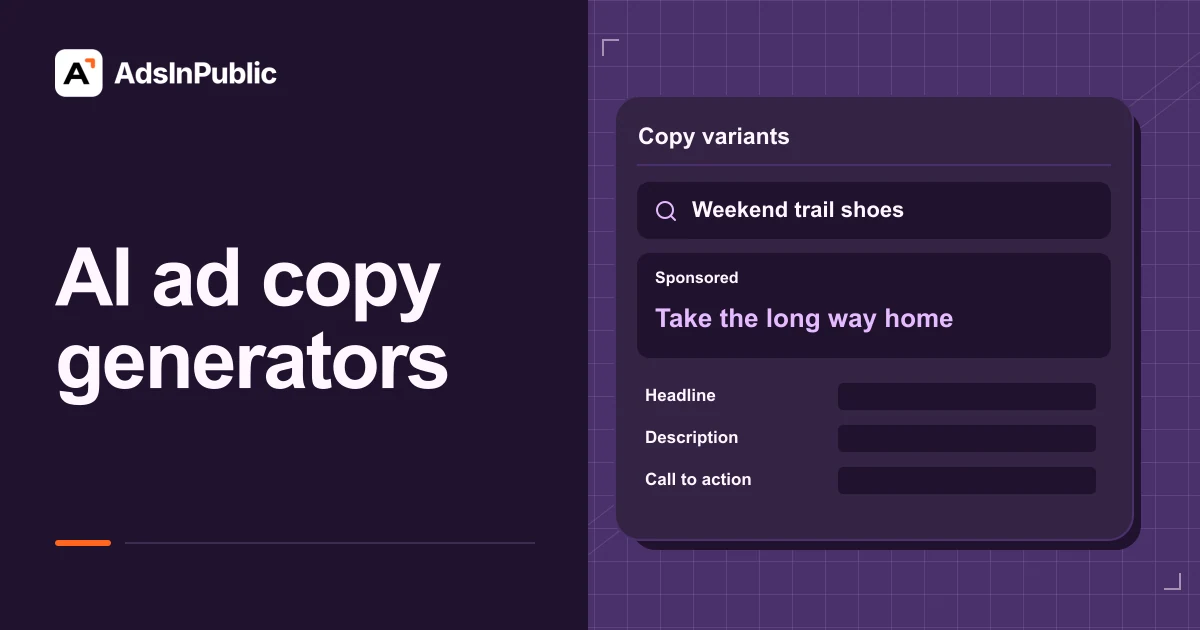
If you mainly advertise on Facebook, start with Meta’s built-in text generation. Ads Manager can produce up to five variations of primary text and headlines per ad at no extra charge. Jasper, Copy.ai, Anyword, ChatGPT and Gemini can draft across channels, including Google and LinkedIn. Anyword adds predictive scoring, and AdCreative.ai also generates visuals. Review drafts against each platform’s policies before publishing. On Meta, for example, “Are you Christian?” makes an assumption about the reader that “Date Christian singles!” avoids.
The 9 tools at a glance
| Tool | Best for | Verified price | Notable limit |
|---|---|---|---|
| Meta Advantage+ text generation | Facebook/Instagram primary text + headlines | Free (in Ads Manager) | Meta-only |
| Anyword | Predictive performance scores | $49/mo ($39 annual) | 50 predictions/mo at Starter |
| AdCreative.ai | Copy paired with scored visuals | From $39/mo | Credits on download |
| Jasper | Multi-channel campaigns from briefs | $69/mo ($59 annual) | No named ad templates |
| Copy.ai | Workflow automation for teams | $29/mo (Chat) | Workflow credits on higher tiers |
| Simplified | Copy + design + scheduling in one | $19/mo (annual) | 1 seat at Pro |
| Hypotenuse AI | Ecommerce product copy at scale | Custom pricing | No public prices |
| ChatGPT | General-purpose drafting | Free tier; paid plans per user | Prices regional/not listed |
| Gemini (Google AI plans) | General-purpose, Google ecosystem | Regional pricing | Regional price display |
1. Meta Advantage+ text generation: the free native option
Inside Meta Ads Manager, Advantage+ creative’s text generation creates “up to 5 variations of primary text and headline,” with the option to generate variations using personas, plus text improvements that surface key phrases as overlays (Meta’s Advantage+ creative documentation). Ads created or edited with these generative features may carry an “AI info” label, and regulated verticals have restricted access to some features. For Facebook and Instagram, this is the highest-value starting point on this list. It costs nothing beyond ad spend, and the variations feed directly into Meta’s delivery system. It does nothing for Google or LinkedIn, which is why multi-channel teams pair it with a general-purpose tool below.
2. Anyword: copy with performance prediction
Anyword’s differentiator is scoring: it “generate[s] AI-powered content using performance prediction scores to know which assets will perform best before you go live” (Anyword pricing). Verified plans: Starter $49/month ($39 annual, 1 seat, 50 performance predictions, unlimited copy generation), Data-Driven $99/month ($79 annual, 3 seats, 100 predictions), Business and Enterprise custom (custom-built AI models, private LLM, API). The prediction scores are a vendor model. Treat them as a ranking signal for which drafts to test, not a guarantee. The 7-day trial caps at 2,500 words, enough to score a real ad set before paying.
3. AdCreative.ai: copy and creative in one pipeline
AdCreative.ai lists ad copy among its outputs alongside banners, product photoshoots, and UGC-style videos, with performance scoring and competitor insights built in (AdCreative.ai). Verified pricing: Starter from $39/month, Professional $249/month, Ultimate $999/month, credits charged only on download, 7-day trial. Its advantage for ad teams is the pairing: headline variants arrive attached to the creative they’ll run with, which is how Meta and Google actually consume copy as as part of an asset, not a standalone document. For copy-only budgets, the dedicated writing tools below are cheaper.
4. Jasper: campaigns from briefs, multi-channel
Jasper’s current lineup is Pro at $69/month per seat ($59 annual, 12-month commitment) and Business at custom pricing, with a 7-day trial (Jasper pricing). Its Campaigns feature “transform[s] briefs, insights, & channel requirements into on-brand campaign content,” and Remix repurposes existing assets across channels; brand-voice controls and 100+ marketing agents ship on both plans. One honest note from the pricing page itself: Jasper does not name Facebook- or Google-specific ad templates among its features. It’s a multi-channel content engine, and ad copy is one output among many rather than a specialized workflow.
5. Copy.ai: workflow automation for copy at team scale
Copy.ai’s entry plan is Chat at $29/month ($24 annual) with five seats and “unlimited words in chat” across OpenAI, Anthropic, and Gemini models (Copy.ai pricing). The higher tiers (Growth $1,000/month (20,000 workflow credits, 75 seats), Expansion $2,000, Scale $3,000) are built around automated workflows rather than single prompts: generate ad variants per audience segment, feed outputs into approvals, and repeat on schedule. In November 2026, Copy.ai listed paid plans only. The workflow tiers are priced for larger teams.
6. Simplified: copy, design, and scheduling bundled
Simplified’s Pro plan ($19/month annual, $29 monthly) includes “Ad creative generation” alongside design, video, writing, and social scheduling tools, with brand style/voice controls; Business ($49/$79) adds seats and accounts (Simplified pricing). For small teams that want one subscription covering the ad-creative stack (copy plus the visual it runs on plus the calendar that schedules the organic version). It’s the most bundled option here. The limitation is focus: it’s a general marketing suite, and dedicated ad tools go deeper on scoring and platform-specific formats.
7. Hypotenuse AI: ecommerce product copy at scale
Hypotenuse’s plans are quote-based (Basic custom, Ecommerce Enterprise custom), with a feature table that names “Facebook captions, Instagram captions, Google ads” among its content types alongside a product-description generator and PIM/taxonomy management for catalogs (Hypotenuse AI pricing). It earns its place for the ecommerce case the other tools handle worst: thousands of SKUs needing consistent, compliant ad and description copy. No public pricing means you’ll negotiate; treat the demo as the trial.
8. ChatGPT: the general-purpose drafting layer
ChatGPT’s plans run Free, Go, Plus, and Pro, with paid tiers “priced per user per month”, though the exact figures don’t display consistently by region (our November 2026 check served a regional page without rendered prices), so verify at signup (ChatGPT pricing). As an ad copy generator it’s unstructured but flexible: paste the platform, format, character limits, audience, and offer, and it drafts variants fast. Then paste platform policy alongside it and ask for compliance checks. The costs of that flexibility are discipline: no performance scoring, no built-in brand voice memory unless you supply it, and no guarantee the model knows this month’s ad policies.
9. Gemini (Google AI plans): the Google-ecosystem drafting layer
Gemini can draft ad copy and comes with Google’s AI plans, which also bundle Flow credits for video. Pricing varies by region. For responsive search ads, draft 3 to 15 headlines of up to 30 characters and 2 to 4 descriptions of up to 90 characters. Google AI plans and responsive search ads.
Brief the generator like a copywriter, or get generic output
The difference between useful and useless AI ad copy is almost entirely the brief. A weak brief (“write Facebook ads for my online store”) produces the same ad as every other store, because the model fills the gaps with category defaults. A strong brief names five things: the audience callout (“clinic owners who hate no-shows”), the one concrete outcome (“cut invoice processing from 6 hours to 40 minutes”), the proof element (“2,300 practices switched”), the offer (“first month free”), and the format constraints (“3 headlines under 30 characters, 2 descriptions under 90”). Then generate against each of those separately: five audience callouts, five outcome framings, five offer framings, structural variants, not reworded duplicates. The final craft step stays human: read every draft aloud, cut anything that sounds like an ad from 2015, and keep only lines a stranger would stop for. Tools accelerate the variant math; they don’t replace the judgment of what’s worth testing.
Character limits and formats to enforce before you paste
Generated copy is useless if it doesn’t fit the slot. Google’s responsive search ads take 3–15 headlines of up to 30 characters and 2–4 descriptions of up to 90 characters (Google’s responsive search ads documentation). Ask the generator for the character count explicitly, since models routinely overshoot. Meta’s Reels ads guidance recommends primary text of around 44 characters (Meta’s Reels ads guide): one line, one idea. Headlines for LinkedIn and other placements follow each platform’s published specs; enforce them mechanically (a character-count check takes seconds) rather than trusting the model’s sense of “short.”
The compliance layer no generator handles for you
Ad copy has platform-specific legal tripwires that generic generators cross routinely. On Meta, the personal-attributes policy bans ads that “assert or imply personal attributes”: the platform’s own examples: “Are you Christian?” violates while “Date Christian singles!” doesn’t; “Depression getting you down? Get help now.” violates while “Depression counseling” doesn’t (Meta’s personal attributes policy). Testimonial copy must satisfy the FTC’s endorsement and fake-review rules: honest opinion, disclosed material connections, no invented customers (FTC’s Endorsement Guides FAQ). And on Google, every generated headline has to fit the RSA character limits before it’s useful. The workflow that works: generate 10–20 variants with any tool above, then filter through the platform’s own policy pages and character limits before anything ships. Review the final copy against the platform’s requirements before uploading it.
How to choose an AI ad copy generator
Compare tools by the channels you write for, how you test drafts and how many people need access.
- Match the tool to the channel mix. Meta-only advertisers should exhaust Advantage+ text generation before paying for anything; Google-heavy accounts need a general-purpose drafter plus RSA discipline; LinkedIn copy is general-purpose AI territory since no tool here publishes a LinkedIn-specific generator.
- Scoring beats volume for testing. Anyword’s prediction scores and AdCreative’s creative scoring rank drafts before spend; ChatGPT and Gemini produce volume that only your testing can rank.
- Seats and workflows define team value. Copy.ai’s workflow tiers and Jasper’s campaigns are team products; Simplified bundles for small teams; Anyword’s seat costs ($49–$59 per extra seat) matter at headcount.
Frequently asked questions
Can AI write ad copy that passes platform review? Usually, with human filtering. The generators don’t know each platform’s current policies (Meta’s personal-attributes examples, restricted categories, and character limits change), so the reliable workflow is generate-many, filter-against-policy, then test. An ad that implies the viewer has a medical condition or financial status will fail review regardless of how good the model thought it was.
What’s the cheapest way to generate ad copy? Free: Meta’s built-in text generation for Facebook/Instagram (five primary-text and headline variations per ad) plus the free tiers of ChatGPT and Gemini for Google and LinkedIn. Paid: Simplified Pro at $19/month or Copy.ai Chat at $29/month are the lowest verified entry points among dedicated tools; Anyword’s $49 Starter is the entry point if you want performance scoring.
Do these tools integrate with Google Ads or LinkedIn directly? Fewer than older listicles claim. Anyword mentions marketing-channel integrations on its Business and Enterprise plans; Copy.ai and Jasper support API and workflow connections; Meta’s text generation is native to Ads Manager. Most teams still copy-paste into Google Ads and LinkedIn Campaign Manager. Plan for that step rather than assuming automation.
Should I worry about AI copy sounding the same as competitors’? Yes, and the fix is inputs, not tools. Generators trained on the same public internet converge on the same phrasing when given generic briefs (“best,” “trusted,” “innovative”). Feed each tool your specifics (the audience callout, the concrete outcome, the proof element) and your copy diverges from competitors using the same tool with lazier inputs.
Do I still need a copywriter if I have one of these tools? For high-volume ad testing, no. The generator plus a disciplined brief covers most variant production. For positioning, offer design, and compliance-sensitive categories (health, finance, regulated products), yes: those are judgment calls about claims and legal exposure that drafting tools don’t make, and the cheapest place to discover a claim problem is before it runs, not after it’s rejected or flagged. The realistic division: copywriter designs the message architecture, AI fills the variant matrix.
Sources and references
Pricing and features reflect vendor documentation from November 2026.
- Meta: About Advantage+ creative. Text generation up to 5 primary-text and headline variations, personas, text improvements, AI info labels, restricted verticals.
- Anyword pricing. Starter $49 ($39 annual), Data-Driven $99 ($79 annual), performance prediction scores, 7-day trial (2,500 words).
- AdCreative.ai. Ad copy among outputs; Starter from $39/month, credits on download, 7-day trial.
- Jasper pricing. Pro $69/month ($59 annual), Business custom; Campaigns and Remix features; no named ad templates.
- Copy.ai pricing. Chat $29/month ($24 annual, 5 seats); Growth $1,000/month with 20K workflow credits; no free plan shown.
- Simplified pricing. Pro $19/$29, Business $49/$79, Growth $149/$199; “Ad creative generation included” on Pro.
- Hypotenuse AI pricing. Custom-priced plans; Facebook/Instagram/Google ad content and product description generator; PIM/taxonomy support.
- ChatGPT pricing. Free/Go/Plus/Pro plan structure, per-user-per-month billing; regional price display noted.
- Google AI plans overview. Regional prices and included Flow credits.
- Google Ads Help: About responsive search ads. 3–15 headlines (30 characters), 2–4 descriptions (90 characters).
- Meta: Privacy violations and personal attributes policy. Banned/implied attribute examples for ad copy compliance.
- FTC: Endorsement Guides FAQ. Honest-opinion and disclosure requirements for ad copy featuring testimonials.